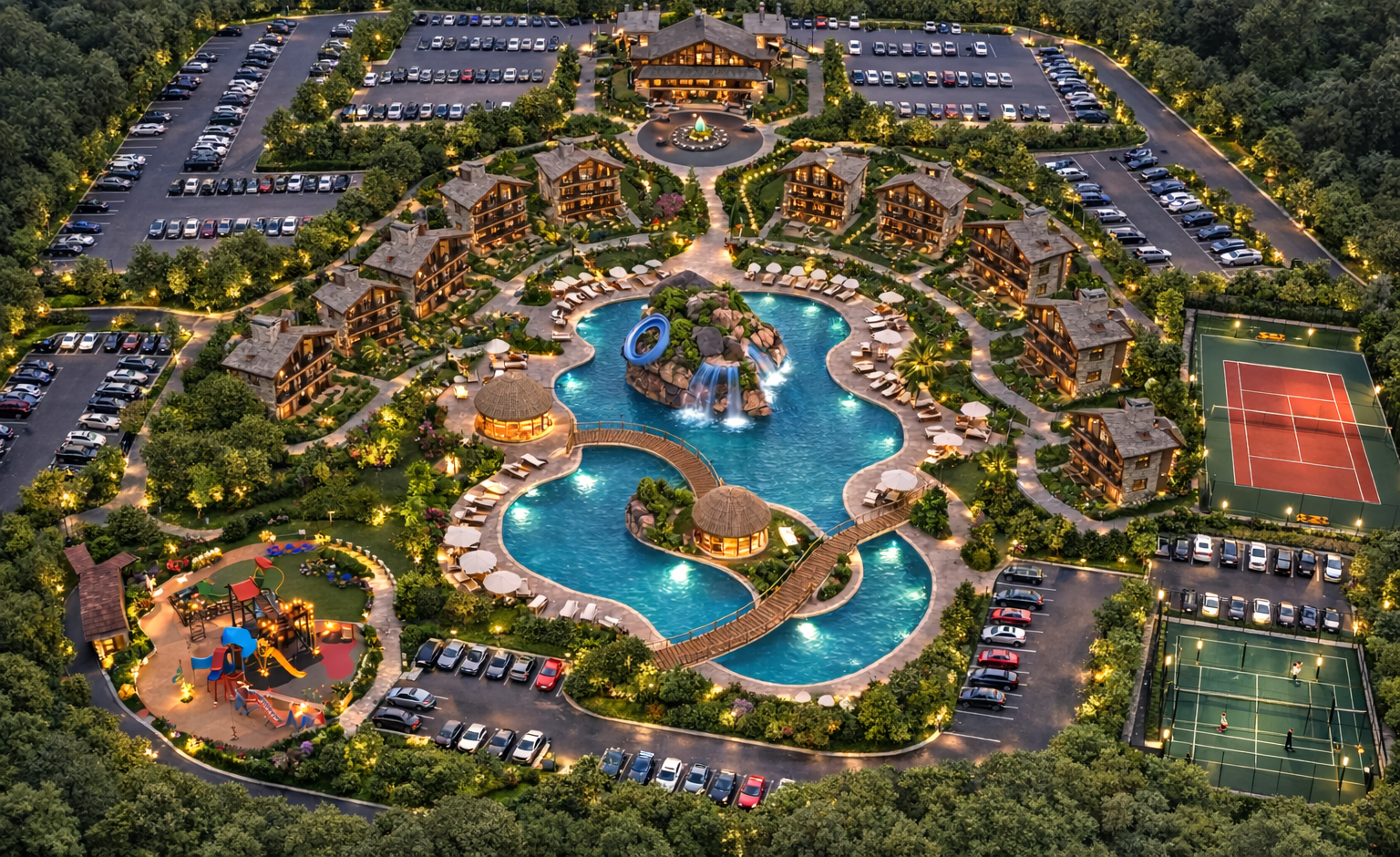
Swiss Village Club — Whitepaper

Executive Summary

What the project is, why it exists, and how investors benefit.

Project Thesis

Swiss Village Club targets a consistent demand lane: short-stay, weekend, and seasonal hospitality in Lebanon driven by domestic tourism, diaspora travel, and special occasions. The concept competes on a premium experience: Swiss-style architecture, strong landscaping, and monetizable amenities.

  • Hold & operate: hospitality cashflow vs. resale speculation.
  • Dual benefit lanes: distributions (cash) + stay privileges (lifestyle).
  • Incentivized growth: optional Host Partner commissions to drive occupancy.

Offering Snapshot

  • Concept size: 220 Swiss-style chalets (illustrative).
  • Land target: +30,000 sqm (illustrative).
  • Share price: $25,000 per share (illustrative).
  • Total raise: $14,675,000 (illustrative draft).
  • Allocation method: 4 phases, each with a maximum cap.
  • Compliance: KYC + proof of funds/income + AML screening.
Important: numbers and structure are placeholders until finalized by counsel and validated against the final land/permit/contractor plan.

Project Overview

What is being built and how it makes money.

Assets

  • Swiss-style chalet units designed for short-stay rental.
  • Signature pool/lagoon core with strong visual identity.
  • Guest experience zones: landscape paths, family areas, sports courts.
  • Paid amenities lane: food & beverage, events, experiences.

Demand Lanes

  • Domestic weekends (family + couples)
  • Summer / holiday peaks (diaspora travel)
  • Micro-events (birthdays, engagements, brand shoots)
  • Off-season conversion via value packages and hosts

Revenue Engines

  • Core: nightly stays (ADR × occupancy × units)
  • Upsell: restaurant + café + experiences
  • Events: curated zones, controlled capacity
  • Host channel: tracked bookings via host investors
Design principle: the resort is engineered for “visual desirability” (bookings + share demand) and “monetizable circulation” (guests naturally pass through paid points: F&B, activities, experiences).

Investment Model

SPV equity participation, distributions, stay privileges, and the optional Host Partner program.

SPV Equity Shares

Investors participate through a dedicated project SPV (Special Purpose Vehicle). Shares represent an ownership interest in the SPV and economic rights defined by executed legal documents.

  • Registry: shareholder registry and transfer rules (approval + compliance).
  • Governance: reserved matters and reporting policy (finalized in docs).
  • Alignment: operator incentives tied to guest experience + NOI.

Separated Benefit Lanes

  • Cash Lane: distributions from operating profits after costs + reserves.
  • Lifestyle Lane: stay privileges (credits) attached to shares.
  • Optional Earnings: Host Partner commissions for tracked bookings.
Why separate lanes: it prevents confusion between “use-value” (stays) and “cash-value” (distributions). Final rules are defined in legal docs.

Distributions

Distributions are paid from a defined distribution pool after operating expenses, maintenance cycles, taxes/fees (if any), and a reserve policy designed for long-term asset protection.

  • Cadence: quarterly/annual (policy-based)
  • Reserves: maintenance + capex buffers
  • Reporting: periodic operating + financial updates

Stay Privileges

Stay privileges are expressed as annual stay credits per share. Credits can be policy-tiered by phase to reward earlier-stage risk. Credits are subject to booking windows, capacity controls, and blackouts (all finalized in legal docs).

  • Credits per share per year (illustrative)
  • Phase-based multipliers (illustrative)
  • Peak/off-peak rules (policy)

Host Partner Program

Investors may opt-in to earn commissions on eligible bookings they generate through a unique tracking code/link and verified attribution. Commission rates may include phase-based bonuses (illustrative).

  • Tracking link/code per host investor
  • Anti-abuse rules and audits
  • Payout timing after stay completion window
Transferability: share transfers (if permitted) require issuer approval, compliance re-checks, and completion of legal transfer documentation.

Phased Allocation

Capped participation by phase, milestone-gated progression, incentive-based (not valuation-based).
Phase Stage Max Investors Shares Capital Raised Early-Entry Advantages
Phase 1 Land + Permits 73 73 $1,825,000 Stay credits 1.25× • Booking priority highest • Host bonus +2%
Phase 2 Infrastructure 147 147 $3,675,000 Stay credits 1.15× • Booking priority high • Host bonus +1%
Phase 3 Chalet Construction 220 220 $5,500,000 Stay credits 1.05× • Booking priority medium • Host standard
Phase 4 Completion + Launch 147 147 $3,675,000 Stay credits 1.00× • Booking priority standard • Host standard

Phase Close Rule

  • Automatic close: a phase closes when its allocation cap is filled.
  • Milestone gating: next phase can require documented progress (permits, contracts, infrastructure completion).
  • Fixed share price: incentives change by phase; share price can remain fixed (finalize in docs).

Operations Model

How the resort runs day-to-day and protects brand quality.

Operating Principles

  • Quality control: brand standards for units, housekeeping, F&B, and guest journey.
  • Controlled capacity: keep experience premium; price rises with demand.
  • Maintenance discipline: reserve policy to avoid asset degradation.
  • Data-led pricing: peak/off-peak packages and minimum stay rules.

Distribution Channels

  • Direct: website bookings + CRM.
  • OTAs: selective use for fill and discovery (policy).
  • Host channel: investor hosts bring demand with tracked attribution.
  • Events: curated calendar for off-peak conversion.
Host alignment: hosts earn from bookings they generate; the resort benefits via occupancy and amenity spend.

Financial Model

Lebanon-realistic scenario framework (illustrative). Final economics depend on executed plan and performance.
Category Assumption Conservative Stabilized Base Upside
Units Total chalets 220 220 220
Nightly Rate (ADR) Average blended rate $180 $220 $250
Occupancy Annual average 30% 40% 55%
Total Chalet Revenue 220 × ADR × (365×occ) $4,336,200 $7,066,400 $11,041,250
Paid Amenity Revenue
restaurant + experiences + events
Incremental revenue $220,000 $366,667 $825,000
Total Gross Revenue Chalets + amenities $4,556,200 $7,433,067 $11,866,250
Operating Costs (All-in) Staffing, utilities, maintenance, cleaning, marketing, systems 50% 45% 40%
NOI Gross × (1 - cost %) $2,278,100 $4,088,187 $7,119,750

Gross Revenue (Relative)

Conservative
$4,556,200
Stabilized Base
$7,433,067
Upside
$11,866,250
Bars scaled to Upside = 100%.

NOI (Relative)

Conservative
$2,278,100
Stabilized Base
$4,088,187
Upside
$7,119,750
NOI is the base for the distribution pool after reserves (policy).
Distribution pool logic (illustrative): NOI → subtract reserve allocation → remaining pool × distribution ratio → shareholder distributions pro-rata. Distribution ratio, reserves, and cadence are defined in executed documents.

Use of Proceeds

Illustrative allocation of raised capital; final budget is set by contractor pricing and approvals.

Land

$2,018,000 — acquisition/coverage and land-related requirements.

  • due diligence and legal structure
  • survey, design coordination

Development

$10,273,000 — chalets + infrastructure + core amenities.

  • civil works + utilities
  • unit construction
  • pool core + landscaping

Runway & Reserves

$2,384,000 — operating runway + buffers.

  • pre-opening operations
  • marketing systems + launch costs
  • maintenance/capex reserves
Budget integrity rule: reserve policy exists to prevent “nice opening, slow decay.” Premium resorts win by staying premium.

Governance and Reporting

How investors get clarity and how key decisions are handled.

Governance Framework

  • Reserved matters: major actions requiring investor approval (finalize in docs).
  • Operator mandate: quality standards + performance KPIs.
  • Conflict handling: disclosure + related-party rules (policy).

Reporting Policy

  • occupancy, ADR, RevPAR, channel mix
  • operating cost ratios, NOI tracking
  • reserve account and maintenance schedule
  • phase milestone evidence (permits/contracts)

Compliance and Eligibility

Compliance-first onboarding; acceptance is not automatic.

KYC

  • identity verification
  • proof of address (if required)
  • document authenticity checks

AML Screening

  • sanctions screening
  • PEP checks
  • risk scoring and adverse media (if used)

Proof of Funds

  • source of funds / income evidence
  • eligibility declarations
  • jurisdiction restrictions (if any)
Acceptance policy: subscriptions may be rejected or delayed to satisfy legal requirements, risk policy, or jurisdictional limitations.

Risk Factors

Non-exhaustive. Final risks are in legal offering documents.

Project and Market Risks

  • permit/timeline delays; contractor performance risk
  • cost inflation; supply chain disruptions
  • demand variability; seasonality; competitive pressure
  • macro and political/economic volatility

Operational and Legal Risks

  • operational execution and quality control risk
  • regulatory/compliance changes; tax treatment uncertainty
  • illiquidity: transfers restricted; no guaranteed exit
  • force majeure: natural events, emergencies, disruptions
Capital at risk: participation may involve partial or total loss of capital and illiquidity. Only proceed if suitable under your circumstances and permitted by law.

Roadmap

Milestone progression aligned with phased allocation.

Phase 1

  • land and legal structuring
  • concept design and budget validation
  • permits pathway confirmation

Phase 2

  • infrastructure and utilities
  • core resort spine + access works
  • procurement and contractor awards

Phase 3–4

  • unit build-out and landscaping
  • amenities and F&B launch
  • soft opening → stabilized operations
Milestone evidence: each phase can require documented completion (permits, contracts, inspection sign-offs) before the next phase opens.